
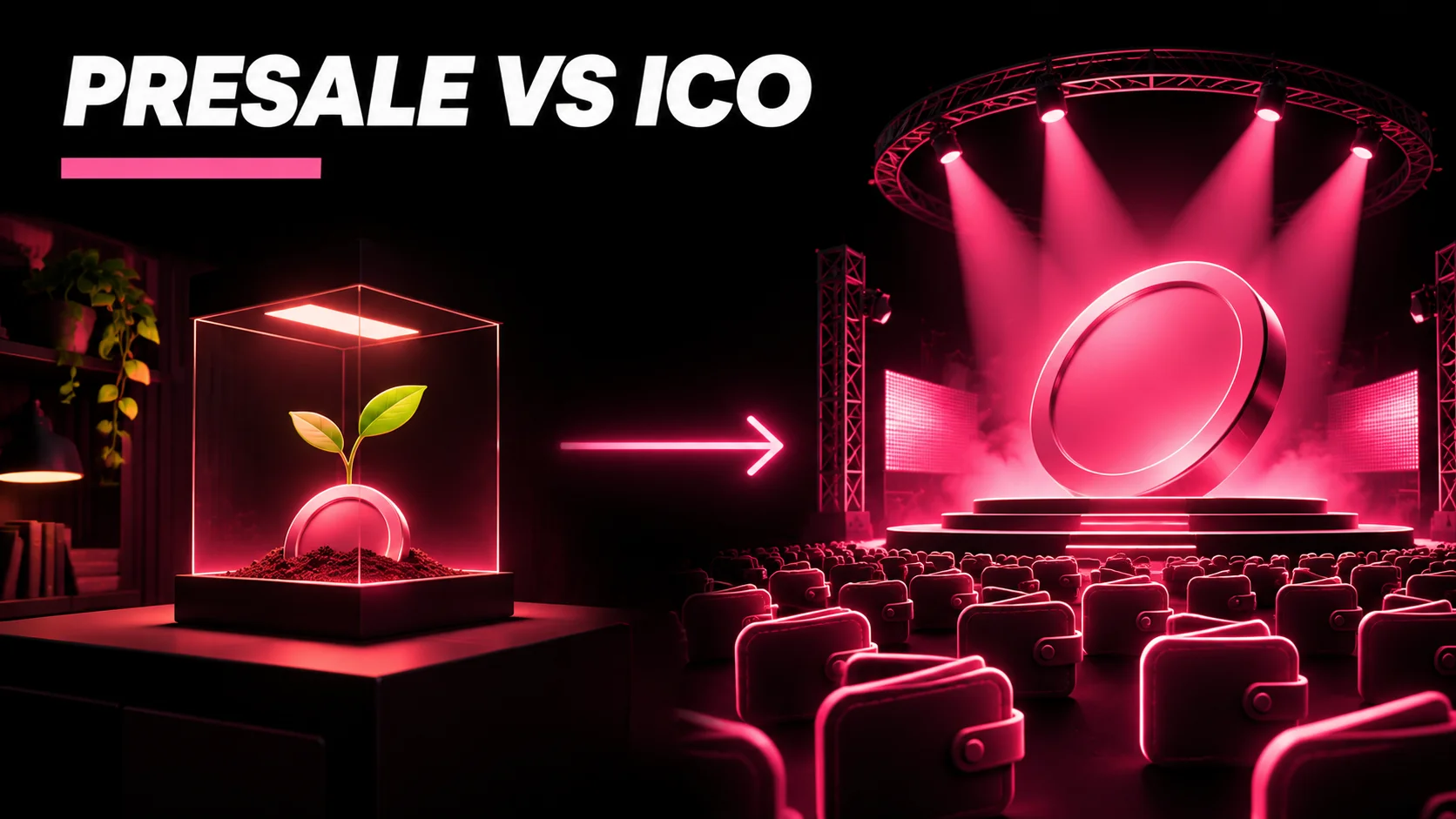
"Crypto presale" and "ICO" are used as if they mean the same thing — and half the time, they do. But the terms describe different moments in a token's life, and the difference matters when you are deciding what to buy and when. A presale is usually the earliest round of a token sale, offered before the main public sale at the lowest price. An ICO — an initial coin offering — is the main public sale itself. In practice the line has blurred, because many projects today run a staged presale as their entire sale and never hold a separate event called an ICO.
This article explains the distinction properly, shows how the two fit together in a real fundraising path, and compares them on price, access, risk, and timing — so you can tell, for any sale you are looking at, which one it actually is. For the background on each term alone, see what a token presale is and what an ICO is.
| Crypto presale | ICO | |
|---|---|---|
| When | Earliest round, before the public sale | The main public sale |
| Who can join | Often a smaller group; sometimes allowlist or early community | Anyone with a wallet (in the classic model) |
| Price | Lowest price, sometimes with a bonus | Fixed price, or staged prices |
| Size | Smaller allocation, earlier risk | Larger allocation, the main raise |
| Today | Often the whole sale, run in stages | Rarely a standalone event any more |
A token's fundraising usually runs in order. First comes the private round, if there is one: a small sale to early backers, often at the lowest price, sometimes with a lock-up. Then the presale: an early public round at the lowest public price, sometimes with a bonus for larger purchases. Then the ICO: the main public sale, open to everyone at a fixed or staged price. Then the listing: the token starts trading on exchanges, and the sale price becomes history.
That path made sense when ICOs were the main event. But the market has compressed it. Many projects now skip the separate ICO entirely and run the presale as the whole sale: staged prices from the first stage to the last, with the earliest stage as the cheapest entry and the listing directly afterwards. The $PHEW sale works this way. It is a staged presale with ten stages: Stage 1 is $0.01, the price rises about 20% at every stage to $0.0516, and the stated listing target is $0.258. There is no separate ICO after it — the presale is the sale, and the listing follows it. The full schedule is in PHEW presale stages explained.
The core difference is price over time. A presale exists to reward the earliest buyers: the first stage is the cheapest price the token will ever sell for, and each stage after it costs more. A classic ICO, by contrast, sold at one fixed price to everyone, whenever they bought. The staged presale keeps the ICO's openness but adds the price ladder: earlier means cheaper, by design, and the schedule is published in advance so buyers can see the next stage's price before it opens.
Bonuses work the same way. A presale often adds a bonus for early or larger purchases — and the honest version is tiered and bounded. On $PHEW, Stage 1 carries a tiered bonus of up to 150% depending on purchase size: under $250 earns +10%, $250+ earns +25%, $1,000+ earns +50%, $2,500+ earns +75%, and $10,000+ earns +150%. A $100 purchase in Stage 1 buys 11,000 $PHEW. The bonus applies in Stage 1 only. Our guide to how presale pricing works explains why staged pricing exists at all.
Access is the second difference. A classic ICO was open to anyone with a wallet: no account, no allowlist, no lottery. A presale is often narrower — an allowlist, an early community, or a first-come window — because the allocation is smaller and the price is lower. That narrowness is the point: the presale rewards the people who found the project first.
Modern staged presales have mostly dropped the allowlist and kept the openness. The $PHEW presale is open to anyone with a wallet, with payment accepted across 11 chains and a minimum buy of $10. The gating that remains is the stage itself: Stage 1 is the cheapest, and once it sells out, it is gone. That is the access rule that matters in a staged sale — not who you are, but when you arrive.
Earlier also means riskier, and the presale's discount is the payment for that risk. A presale buyer commits before the main sale, before the listing, and often before the product is finished. If the project fails to deliver, the presale buyer loses first and most. The ICO buyer commits later, with more information — the presale's progress, the community's size, the product's state — but pays a higher price for that information.
The checks are the same for both. Read the tokenomics: total supply, presale share, team allocation and lock. Check whether the contracts are audited and the team is public. Look for a live product, not just a roadmap. Check the vesting schedule — $PHEW has no vesting, so allocations unlock 100% at launch, and every buyer can trade from day one. And never spend money you need elsewhere: the listing price is a target, and the market may open below it. Our guide on how to spot a good presale is the full checklist.
If a project runs both, the presale is the better price and the higher risk; the ICO is the higher price and the lower risk. Most buyers who find a project early will prefer the presale stage, because the discount and the bonus are the reason to be early. Buyers who find it late will join whatever stage is open, at whatever price that stage charges.
In 2026, the question is usually moot: the sale you are looking at is probably a staged presale that is the whole event, and the real decision is which stage to buy in. Buy in Stage 1 and you pay the lowest price with the bonus. Buy later and you pay more with no bonus. Either way, the checks are the same, the listing target is a target, and the purchase should be sized as a high-risk allocation. The $PHEW presale is live at phew.pro/presale, from October 16 to December 31, 2026.
Not exactly. A presale is usually the earliest round of a token sale, before the main public sale, at the lowest price. An ICO is the main public sale. In practice many projects today run a staged presale as their entire sale, so the terms overlap.
The presale, by design. The earliest stage is the cheapest price, and the price rises at every stage after it. An ICO at a fixed price charges everyone the same.
It depends on the sale. Some presales use an allowlist or an early-community window. Modern staged presales like $PHEW are open to anyone with a wallet, with the stage itself as the only gate: earlier stages are cheaper, and they sell out.
It depends on the project. Some presales lock tokens and release them gradually; $PHEW has no vesting, so allocations unlock 100% at launch. Always check the schedule before buying.
No. The listing price is a target, not a promise. Once the token trades publicly, supply and demand set the real price, and it may be higher or lower than the target.
Stage 1 is $0.01 with a tiered bonus of up to 150%, rising each stage to $0.0516 — and the stated listing target is $0.258, with 100% unlock at launch.
Join the presale