
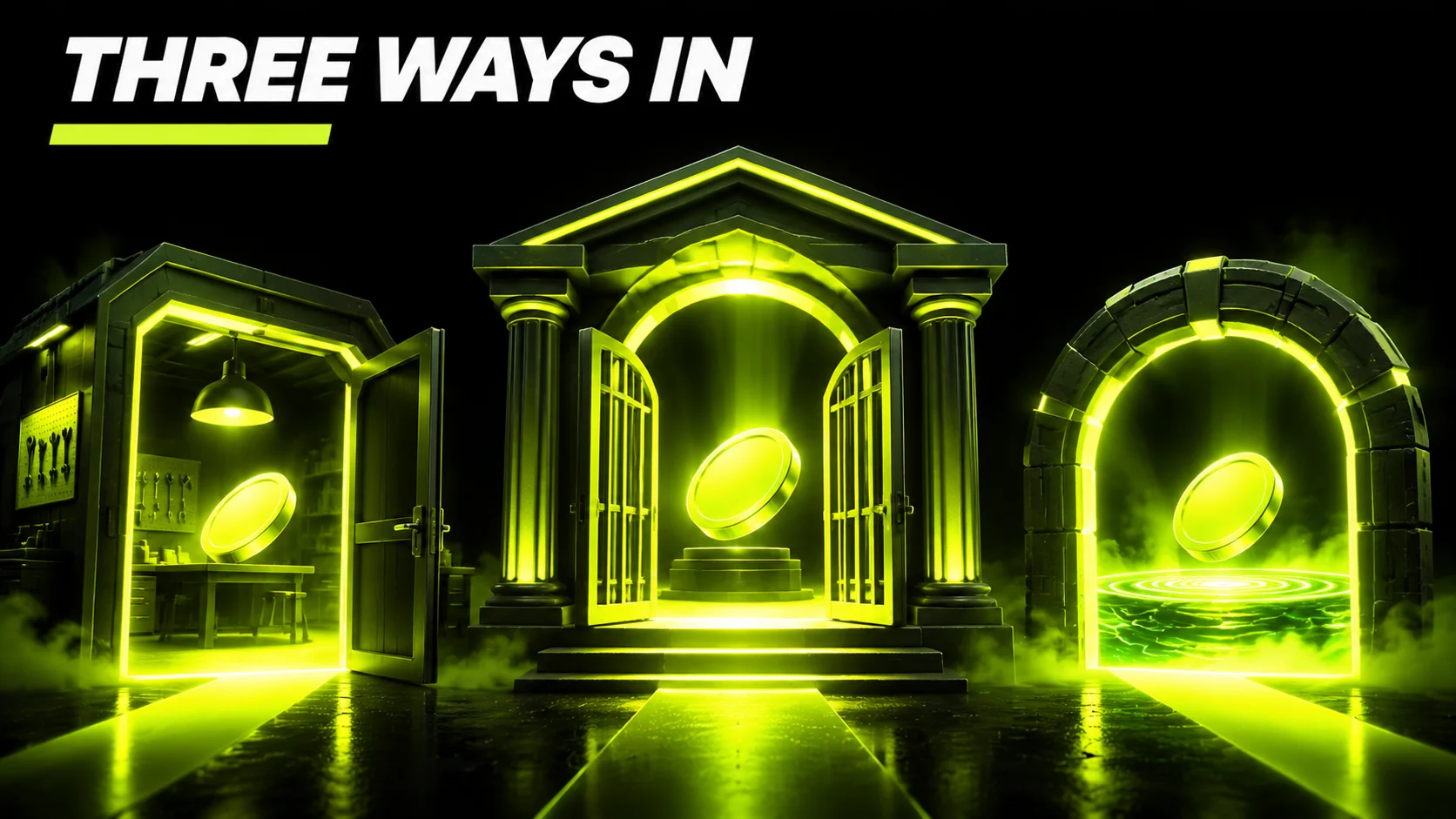
ICO, IEO, and IDO are three ways a crypto project sells its token to the public for the first time — and the letters are the whole story. An ICO (initial coin offering) is run by the project itself. An IEO (initial exchange offering) is run by a centralized exchange. An IDO (initial DEX offering) is run on a decentralized exchange. Same goal, different gatekeeper, and the difference decides who can join, how fast the token trades, and who carries the risk.
This article compares the three models head to head: how each one works, what each costs the buyer and the project, where each fails, and which one makes sense in 2026. If you want the deep dive on one model first, start with what an ICO is, what an IEO is, or what an IDO is.
| ICO | IEO | IDO | |
|---|---|---|---|
| Run by | The project | A centralized exchange | A DEX or launchpad |
| Who can join | Anyone with a wallet | Verified users of that exchange | Anyone with a wallet |
| Vetting | None — buyer checks | Exchange due diligence | None, or light launchpad review |
| Trading after sale | Waits for a listing | Lists on the host exchange | Tradeable immediately in a pool |
| Allocation | Usually open, first come | Lottery or holding requirements | Usually open, first come |
| Main risk | Scams, no market | Small allocations, exchange risk | Scams, fast price moves |
The ICO is the original model. The project publishes its plan, opens a sale through its own smart contract, and sells tokens directly to the public. Ethereum raised funds this way in 2014, and the model exploded in 2017, when hundreds of ICOs raised billions of dollars — including EOS, whose year-long sale raised roughly $4 billion, still the largest ICO on record. The appeal was total openness: no gatekeeper, no account, no permission. The flaw was the same openness. With no vetting and no guaranteed market, buyers carried every risk themselves, and the bust of 2018 followed the boom.
An ICO still makes sense for a project with a strong community and a transparent team, because it keeps full control of the sale and reaches the whole world. For buyers, it demands the most homework: there is no exchange to blame if the project is fake, and no listing to count on if the sale ends. Read the tokenomics, check the audit, confirm the team is public, and check vesting before buying.
The IEO was the industry's answer to the ICO bust. Binance Launchpad popularized it in early 2019: the exchange vetted the project, ran the sale on its own platform, and listed the token afterwards. The first sale, BitTorrent Token, sold out in minutes, and the model spread to other exchanges within months. The exchange's reputation became the filter that ICOs lacked.
The cost of that filter is access. IEO demand almost always exceeds supply, so exchanges ration allocations through lotteries and requirements to hold the exchange's own token. Most users who want in cannot get a meaningful allocation. The token also lives or dies with the host exchange: a delisting can destroy its liquidity. IEOs suit buyers who already use the exchange and want a curated, low-friction sale — and they suit projects that can pass a major exchange's review. For everyone else, the door is mostly closed.
The IDO keeps the openness of the ICO and adds the instant market the IEO promised. The sale runs on a decentralized exchange: tokens are sold into a liquidity pool, and trading starts the moment the pool opens. There is no account, no lottery, and no waiting for a listing. The model took off in 2020 and 2021 as DEXes matured, and launchpads made it the standard way new tokens reach the market — especially on Solana, where fees are a fraction of a cent and settlement takes seconds.
The trade-off is vetting. Nobody checks the project for you in an IDO, so fake and copycat sales are common, and prices can move violently in a small pool. The buyer's protection is the checklist: confirm the sale is on the official page or a known launchpad, read the tokenomics, check the audit, confirm the liquidity is locked, and look for a real product. The IDO gives buyers freedom and speed; it charges them with doing their own research.
For buyers, the IDO is the working default in 2026: open access, instant trading, and no account requirement. The ICO survives mainly as the earliest, private stage of a sale — the presale round before the public event — rather than as a standalone public model. The IEO survives as a premium lane for projects big enough to pass a major exchange's review, but it serves a small slice of buyers.
The real winner is the hybrid that launchpads built from all three: a standardized, audited sale format (the IEO's discipline), run on-chain with open access and instant trading (the IDO's mechanics), and priced in stages so early buyers pay less (the ICO's original promise). That is how modern presales work. The $PHEW presale is one example: a staged public sale from $0.01 in Stage 1 to $0.0516 in the final stage, with a tiered Stage 1 bonus of up to 150% depending on purchase size — under $250 earns +10%, $250+ earns +25%, $1,000+ earns +50%, $2,500+ earns +75%, and $10,000+ earns +150% — so $100 in Stage 1 buys 11,000 $PHEW. No vesting, 100% unlock at launch, payment across 11 chains, and a stated listing target of $0.258. See the PHEW presale stages explained for the full schedule.
Pick the model by what you value most. If you want a vetted sale and already use the exchange, watch for IEOs — but expect a small allocation. If you want open access and instant trading, use IDOs and launchpads — but do the checks yourself, every time. If a project runs a direct ICO, treat it as the highest-homework option: the team, the audit, and the tokenomics have to stand on their own, because nothing else is standing behind them.
Whichever model you join, the same rules apply. Confirm you are on the official sale page, typed in yourself — never a link from a comment or a DM. Check the total supply, the team allocation, and the vesting schedule. Confirm the liquidity is locked where a pool is involved. And size every purchase as a high-risk allocation: the listing price is a target, and the market may open below it. Our guide on how to spot a good presale is the full version of this checklist.
Who runs the sale. An ICO is run by the project itself, an IEO is run by a centralized exchange, and an IDO is run on a decentralized exchange. That decides who can join, whether the token is vetted, and how fast it trades.
IEOs are safest on average because the exchange vets the project — but vetting is not a guarantee of returns, and allocations are small. IDOs are open and instant but unvetted, so the buyer carries the due diligence. ICOs carry the most homework.
Yes. Many projects run a private presale, then a public IDO, and later seek a centralized listing. The models are stages of one fundraising path as often as they are alternatives.
Usually not. IDOs are permissionless: anyone with a compatible wallet can join. IEOs, by contrast, require a verified exchange account and identity checks.
The IDO and the launchpad presale. Open access, instant trading, and standardized sale contracts have made them the default, with IEOs as a premium lane for the largest projects.
Stage 1 is $0.01 with a tiered bonus of up to 150%, rising each stage to $0.0516 — and the stated listing target is $0.258, with 100% unlock at launch.
Join the presale