
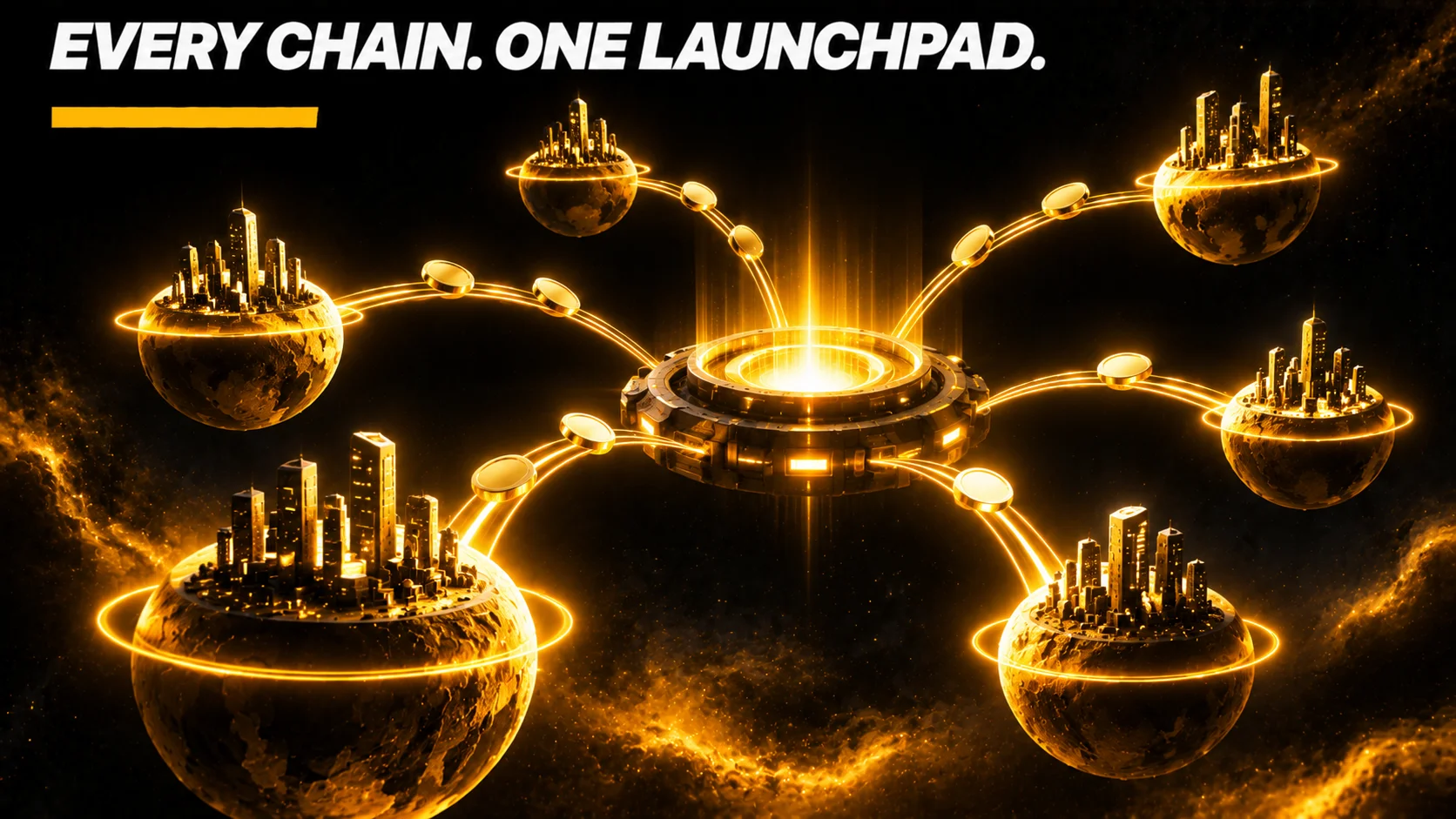
A launchpad is a platform where new tokens are created and first traded. A multichain launchpad does the same thing on more than one blockchain. That sounds simple, but the word multichain is used loosely, and two platforms can both call themselves multichain while meaning very different things. This guide explains what multichain means in practice, which chains Phew supports, how its bonding curves work, and what graduation to Uniswap v4 means for a token that starts on Phew.
At its simplest, multichain means the platform operates on several blockchains instead of one. For a launchpad, that has three practical consequences. First, creators can launch where their audience already is, rather than asking every buyer to bridge to a single chain. Second, buyers can pay and trade with the assets they already hold on that chain. Third, the platform has to handle the differences between chains — different gas tokens, different speeds, different costs — without making the launch itself confusing.
There is also a weaker sense of multichain that is worth recognising. Some platforms accept payment from several chains but only launch tokens on one. That is multichain payments, not a multichain launchpad, and the distinction matters if you want to launch rather than just buy. When a platform says it is multichain, ask which chains support launching, not just paying. Phew accepts presale payment across 11 chains, and launching is live on Robinhood Chain, Elysium, BNB Chain, and Ethereum, with Solana launches on the way. Those are two different lists, and both are worth knowing.
Launching is live on four chains. Robinhood Chain is the chain Phew started on, and it is where the launchpad's earliest tokens launched. Elysium is Kinetiq's Hyperliquid L2, built on Arbitrum Orbit, with chain ID 99901 and HYPE as its gas token. Phew covers Elysium with a live trade panel, so Elysium launches can be traded on Phew itself. BNB Chain and Ethereum are the two largest EVM ecosystems, and launching there puts a token in front of the wallets and liquidity those chains already have.
Solana launches are on the way, and they are not live yet. That matters because $PHEW itself is a Solana SPL token, and it is easy to assume the launchpad already launches Solana tokens. It does not, yet. The presale token is Solana, the launchpad's Solana support is coming, and the two should not be confused. If you are planning a Solana launch, check the current status on the Phew launchpad before you plan around it.
Each chain has its own costs. On Elysium, the launch fee is 0.02 HYPE. That is the fee to launch a token on Elysium, and it is charged in HYPE because HYPE is Elysium's gas token. Launch fees on other chains are set per chain, so check the fee for the chain you plan to launch on rather than assuming one chain's fee applies everywhere. The Elysium launchpad guide explains the Elysium side in more detail, including the chain ID and the trade panel.
Every token on Phew starts on a bonding curve. A bonding curve is a pricing rule: the price of the token rises as more of it is bought, and falls as more of it is sold, according to a fixed formula rather than an order book. When a token launches, there is no order book to fill and no liquidity pool to set up first. Trading starts immediately along the curve, and the price moves with buying and selling.
The bonding curve is also what makes graduation possible. As buyers purchase along the curve, the token accumulates value. Once a token has raised $2,500, or its equivalent in the pair asset, it graduates. That threshold is the same idea on every chain, but the pair asset differs: on Elysium the pair asset can be HYPE or USDC, and the equivalent value is what counts. The bonding curve guide walks through the mechanics step by step, including how the price moves and what happens at each stage of the curve.
Graduation is the step that moves a token off the bonding curve and onto a decentralised exchange. When a token raises $2,500 or its equivalent in the pair asset, it graduates to a Uniswap v4 pool, and its liquidity is locked forever. Locked liquidity means the liquidity in that pool cannot be withdrawn by the creator or the platform. That is a meaningful protection for later buyers, because one of the oldest risks in new tokens is a creator removing liquidity and leaving holders with a token they cannot sell.
$PHEW is the token of the Phew launchpad, and its value is tied to launchpad activity across the chains the platform supports. The launchpad charges a 1% trading fee, split 50% to creators, 40% to the protocol, and 10% to buyback. $PHEW holders get 30% of every trading fee through a holder program that goes live in Q1 2027, and no payouts have been distributed yet. The more chains the launchpad operates on, the more launches and trading can in principle flow through that fee model — but more chains also mean more to maintain, and activity on one chain does not guarantee activity on another.
The $PHEW presale itself shows the multichain idea from the buyer's side. The presale accepts payment across 11 chains, so a buyer can pay with the asset they already hold, while the token they receive is a Solana SPL token with mint address 4RxchRWihDJLisRK4b7VBqvjuYnBnv5u38xyX1ambpZP, 9 decimals, and a supply of 1,000,000,000. The presale runs from October 16 to December 31, 2026, in ten stages from $0.01 to $0.0516, with a stated listing price of $0.258. The real market price after listing may be higher or lower. You can read the full presale details in the $PHEW presale guide and the token allocation on the tokenomics page.
Whether you are launching a token or trading one, check the chain first. Confirm which chain the token launched on, which asset it pairs with, what the launch fee is on that chain, and where it trades after graduation. On Elysium, check that you hold HYPE for gas and for the 0.02 HYPE launch fee. On an EVM chain, check that your wallet is on the right network before you send anything. A token's name alone does not tell you its chain, and the same name can exist on several chains at once.
A launchpad that lets creators launch tokens on more than one blockchain, running the same launch mechanics — bonding curve, trading, and graduation — on each supported chain.
Launching is live on Robinhood Chain, Elysium, BNB Chain, and Ethereum. Solana launches are on the way.
The Elysium launch fee is 0.02 HYPE. Elysium is Kinetiq's Hyperliquid L2, chain ID 99901, with HYPE as its gas token.
Once it has raised $2,500 or its equivalent in the pair asset, it graduates to a Uniswap v4 pool, and its liquidity is locked forever.
Phew launches live on Robinhood Chain, Elysium, BNB Chain, and Ethereum, with Solana on the way. See the launchpad and the $PHEW presale.
Join the presale