
Fees are where a launchpad's business model becomes concrete. They decide what creators earn, what the protocol keeps, what happens to trading revenue, and what token holders receive. Phew's fee structure has two parts that are easy to confuse: the 1% trading fee on the launchpad, and the holder program that gives $PHEW holders a share of trading fees. This guide explains both, with the exact splits, when each part applies, and what has and has not started yet.
The short version is this. Every trade on the Phew launchpad pays a 1% trading fee. That fee is split 50% to creators, 40% to the protocol, and 10% to buyback. Separately, $PHEW holders get 30% of every trading fee through a holder program that goes live in Q1 2027. No holder payouts have been distributed yet. The rest of this guide explains what each of those sentences means in practice.
The trading fee is 1% of each trade on the launchpad. It applies to buying and selling tokens launched on Phew, and it is charged as part of the trade itself rather than as a separate payment you need to make. If you buy a token on the launchpad, 1% of the trade value is the fee, and the remaining 99% is the value that goes into the trade. The fee is the same percentage on every launchpad trade, regardless of the token or the chain, so you can calculate it before you trade: a $100 trade carries a $1 fee, and a $10 trade carries a $0.10 fee.
A flat percentage fee is easy to compare with other platforms, and it is worth comparing, because fees compound. A trader who makes many small trades pays the fee many times, and a creator whose token trades heavily generates a large total fee even though each individual trade is small. The 1% figure is the starting point for all of that arithmetic, and it is the figure to use when you estimate what a trade will actually cost you.
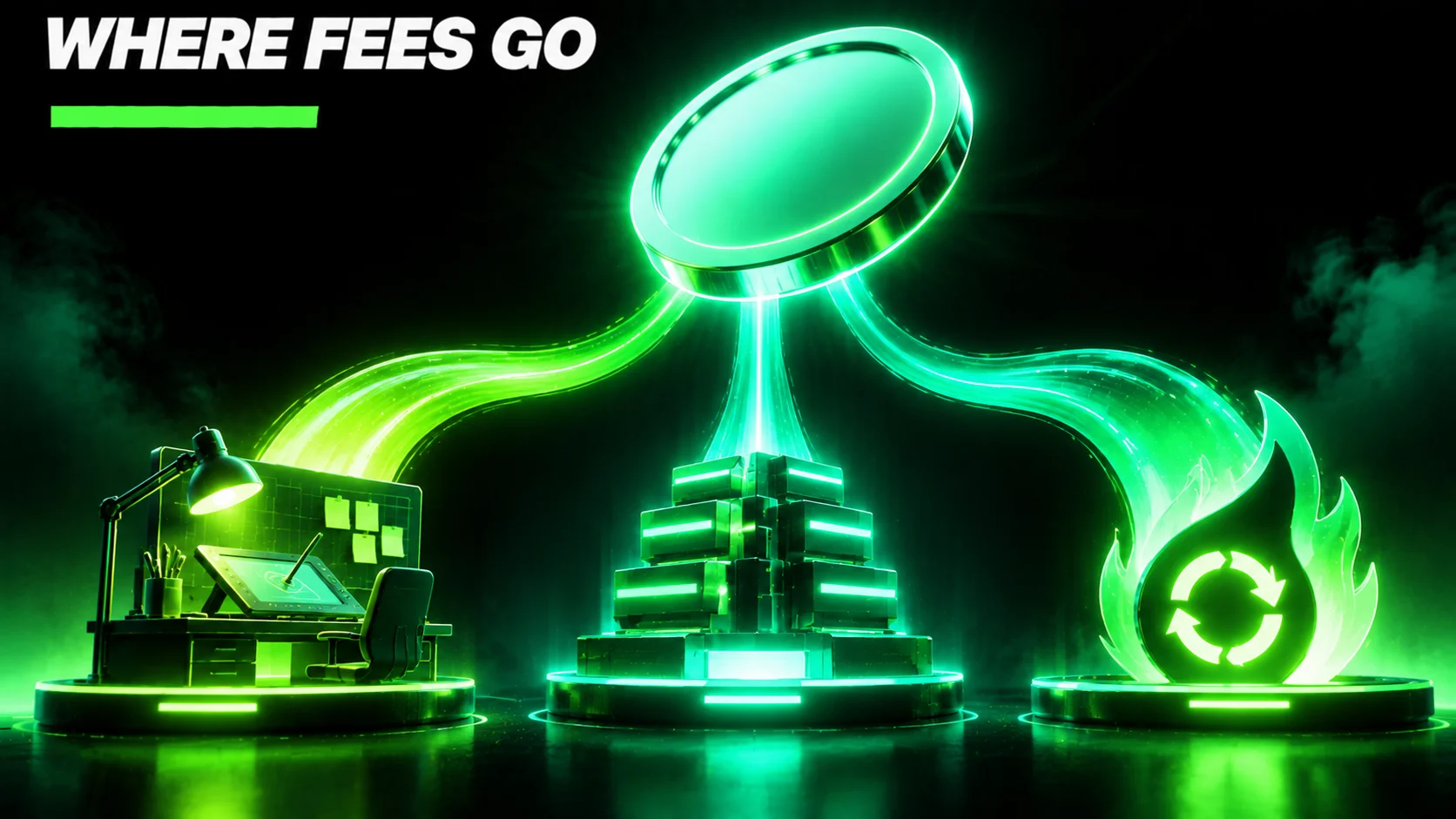
The 1% trading fee is split three ways: 50% to creators, 40% to the protocol, and 10% to buyback. Using the $1 fee on a $100 trade as an example, $0.50 goes to the creator of the token traded, $0.40 goes to the protocol, and $0.10 goes to buyback. The split applies to the fee, not to the trade value: the creator receives half of the 1%, not half of the trade.
Each share has a different purpose. The creator share is the incentive for launching on Phew. A creator whose token attracts trading earns half of the fee on every trade in that token, which is a direct link between a token's activity and its creator's earnings. The protocol share funds the operation of the platform itself — development, infrastructure, and the costs of running a multichain launchpad. The buyback share is set aside for buyback, which is the protocol buying $PHEW. The details of how and when buybacks happen are a protocol decision, and this guide does not add to the published split.
Separately from the fee split above, $PHEW holders get 30% of every trading fee through a holder program. That is the holder benefit of the $PHEW token: holding $PHEW entitles you to a share of trading-fee revenue, distributed through the holder program. The program goes live in Q1 2027. No payouts have been distributed yet, and no one has received holder fee payments so far. Any claim that payouts are already happening would be wrong.
Staking is a separate feature from the holder program, and it is already described in the tokenomics. $PHEW staking plans are Flexible at 8% APY, 30 days at 25% APY, 90 days at 60% APY, and 180 days at 120% APY, paid from the 15% staking rewards allocation of the 1,000,000,000 supply. An APY is a reward rate, not a profit guarantee. The Phew staking guide explains those plans, and the tokenomics page shows the full allocation, including the 40% presale share and the locked 5% team share.
Trading fees are not the only fee on the launchpad. Launching a token also carries a launch fee, and it is charged per chain. On Elysium, the launch fee is 0.02 HYPE. Elysium is Kinetiq's Hyperliquid L2, built on Arbitrum Orbit, with chain ID 99901 and HYPE as its gas token, and Phew covers it with a live trade panel. The launch fee is a one-off cost to create the token, while the 1% trading fee applies to every trade after launch. Do not confuse the two: paying the launch fee does not exempt a token's trades from the trading fee, and the trading fee does not include the launch fee.
Launch fees differ by chain, so check the fee for the chain you plan to launch on. The Elysium launchpad guide covers the Elysium fee and the Elysium trade panel, and the launchpad page is the place to check the current launch options. A creator budgeting a launch should count both the launch fee and the gas for the launch transaction, in the gas token of the chain they are launching on.
For a trader, the practical effect of the fee structure is simple: every launchpad trade costs 1% in fees, and that cost is part of the trade. A token needs to move more than 1% in your favour for a round trip to break even on fees alone, before any other costs such as gas. That is not a reason to avoid trading, but it is a reason to count the fee in your plan rather than discovering it afterwards. Short-term trading on a 1% fee is expensive by construction, and the fee is the same whether the trade wins or loses.
For a $PHEW holder, the fee structure is the link between the launchpad and the token. The 1% trading fee is the revenue the launchpad generates, the 50/40/10 split decides where that revenue goes, and the holder program is the channel through which holders receive their 30% share of every trading fee from Q1 2027. Until the program goes live, that share is a published plan, not a payment. After it goes live, its value will depend on how much trading the launchpad actually attracts, because 30% of a small fee total is a small amount, and 30% of a large fee total is a large one.
The trading fee is 1% of each trade on the launchpad, split 50% to creators, 40% to the protocol, and 10% to buyback.
$PHEW holders get 30% of every trading fee through the holder program, which goes live in Q1 2027. No payouts have been distributed yet.
The Elysium launch fee is 0.02 HYPE. That is a one-off launch cost, separate from the 1% trading fee on trades after launch.
No. Staking pays APY from the staking rewards allocation, with plans from Flexible 8% APY to 180 days 120% APY. The holder program is a separate share of trading fees, starting in Q1 2027.
The trading fee is 1%, split 50% creators, 40% protocol, 10% buyback, and $PHEW holders get 30% of every trading fee from Q1 2027. Join the presale.
Join the presale